From the series about local artists
MY MOTHER
TONGUE WILL NEVER
LOSE ITS CHARM
Z cyklu: Twórcy z Nowej Huty
Mowa ojczysta
nie spowszednieje
mi nigdy
Press interview with Ryszard (Richard) Tylman, poet and art painter living in Canada, by writer Małgorzata Szymczyk-Karnasiewicz. Published in The Voice, Nowa Huta Weekly in Kraków. Translation from the Polish original.[1]
Read the original in Polish.
| |

Małgorzata Szymczyk-Karnasiewicz: You are the author of the poetry chapbooks both in English and Polish: Selections From an Old Shoebox, Living Inside the Moving Landscape, Privilege, Wax Poetics, Imaginary Lovers. Your poetry draws on the literary conventions of philosophical treatise and the contemporary romantic epic. In 2001 you were selected to be featured at the Word On The Street Festival. Last year, The Felines of March were released. It is a selection of poetry written in Poland and in the West over the last two decades. During your stay in Kraków you read poetry at the Audialnia Gallery among other places in April. You have picked that art exhibition venue not by accident ...
Richard Tylman: When The Felines of March were published, I hosted poetry recitals in Vancouver with songs of Chopin and Karłowicz performed by my daughter who is an opera singer. When planning my trip to Poland, I looked for similar connections. The solution arrived by itself. While in Canada I invited a few artist for a show of Polish painting abroad, and found out about Katarzyna Słysz, a painter from Kraków living in Nowa Huta. She invited me to the Audialnia Gallery for her opening of works from the 'Four Elements' series.
M.S-K.: How important to you was the author's reading at the C. K. Norwid Cultural
Centre. Did your friends from 'primary school' came along with others? Or perhaps your school teachers?
R.T.: That poetry reading was the culmination of my meetings with the audience in Poland. It was also the most heart touching experience. My high school buddies showed up at the hall. Many elderly neighbors from the housing estate I grew up in also came. The autographed copies of my book were sold in the blink of an eye. My reading was accompanied by a discussion facilitated by my high school teacher of Polish, currently a fan and supporter of my work, Mgr. Anna Jochym. I was asked for example how the ballad called An Attempt at Blowing Up the Statue of Lenin came into being. My long poem was written not in Poland but in Canada, when the monument at the Avenue of Roses was no longer there. The very idea was born many years before Poland regained its full independence in 1989. The assault on the bronze statue was and still is a symbol of the world of my youth in juxtaposition between the story of Ordon's Redoubt,[2] and the ever-encroaching avalanche of Sovietization. Both here and there the attacks were quintessential; unexplainable by ordinary reasoning, or the instinct of self-preservation. My ballad was partly inspired by an American long poem about the Great Fire of New York. The poetic qualities of the text were not meant to result from the language alone but from an existential perspective to the ways in which the public reacted.
M.S-K.: You visited the Cultural Centre in the Górali estate already as a young man. You took guitar lessons there. It appears that instead of listening to the instructor, you and Paweł Kruczek talked quietly about adult literature in class and ... you both got reprimanded.
R.T.: In the early 1950s my parents were given a state-owned flat at the Plac Centralny Square. Soon later we moved to a 3 bedroom apartment at the Osiedle Urocze housing development. I went to school there. In time I took piano lessons at the community music school. The examiner at the end of my first year told my instructor to keep the windows half-closed because “eagles like to fly.” Her fears were quickly confirmed. I discovered rock-and-roll and without hesitation, switched from piano to guitar.
M.S-K.:You have learned how to paint ... ?
R.T.: ... by attending a painting workshop offered by master artist and mother of Paweł Kruczek, Mgr. Józefa Sobór-Kruczek; held at the DK HiL Youth Alliance in Młodości Estate. I was the youngest member of the Art Center exhibiting there! But aside from that I became friends with the children of Nowa Huta artists. I loved the smell of oil paints filling their apartment-studios. For me, it was the smell of exotic flowers.
M.S-K.: In 1973 with a group of college friends from Nowa Huta you founded the youth broadsheet Skarpa. It was a special-edition issue launched by the Skarpa Club at ZDK HiL Centre. You were published for the first time in its inaugural number. In one of your poems you wrote (“to M ...”):
by the calm tawny hair
like from a flax fiber
spun to life
you have unreeled before me
from the bobbin of feelings
spindle of destiny
(...)
M.S-K.: When did you start writing?
R.T.: My fascination with poetry began in high school when the contemporary literature was introduced in our language courses. I discovered the potential of free verse, which does not use rhyme. I fell in love with this technique at once, and I cherish it to this day, although I do use rhyme and rhythm occasionally. My first poems were dedicated chiefly to beautiful girls in class. These poems never helped me in matters of love, although they led to something much greater in creativity matters. Prof. Zbigniew Siatkowski, rector of the PWST in Kraków was kind enough to provide the following introduction: “You will probably write poems more beautiful than the ones discussed here, but it will be good if you do not lose your full sensitivity and this very humanistic distance towards the woman you write about. This attitude is not just about fitting for a man, but can also reveal miraculous properties directly: youthful poems of love, as in the hundreds of teens' affirmations, can sometimes transform into authentic poetry ...”
A year later, after my debut in "Skarpa" I won the second place in the poetry tournament for the "Great Owl" Award of the Student Club of the Jagiellonian University "Nowy Żaczek". The Jury members included the ZLP members, literary critics and researchers at the Institute of Polish Philology. After these first young successes, I began to treat poetry much more seriously.
M.S-K.: But instead of Polish studies, you chose architecture. Why?
R.T.: My father strongly encouraged me to study architecture, so after graduating from high school I passed the exams to the Kraków University of Technology; however, it soon turned out that I am not interested in the design of building reinforcements. Two years later I decided to enroll at the Academy of Fine Arts. I was stubborn.
M.S-K.: Did you have masters at the Academy?
R.T.: My talent in the years preceding the enrollment to the Academy of Fine Arts kept developing chiefly under the direction of renown Nowa Huta artists, Ewa and Ryszard Mrozowski. In the autumn of 1974, I began my studies in the Faculty of Painting of the Academy. The leading artistic trend at university during this period was Polish colourism, with a leaning toward postexpressionism. Among the younger Polish artists, it was the beginning of a new trend inspired by the directions of Western art such as pop-art and conceptualism. Meanwhile, the socio-political climate of public opposition to the deteriorating reality of communism was captured in the paintings of, among others prof. Zbylut Grzywacz, who was then an assistant at the studio of prof. Buczek. At the end of my studies, I undertook the first experiments with hyperreality. During the graduation year, I was supported in my experiments by prof. Andrzej Strumiłło, painter, traveler and writer, who first compared my new paintings to the work of the American hyperrealist Pearlstein. I was considered a controversial artist. My diploma presentation consisted of oversized almost photographic nudes that aroused protests not only among committee members, but also some of my colleagues. The human figure remains to this day my main painting subject.
M.S-K.: You began your professional career as an assistant set designer at the Ludowy Theatre. You took part in the production of the play “Bethlehem Polskie” by Lucjan Rydel. And suddenly you left Poland with your family in the middle of the night ...
R.T.: Working in theatre, I realized the extent of political control over the world of culture. Besides, it was a "penny" job. In the face of rising inflation, I would not be able to support my family. Close friends escaped from the country without a word of warning, presumably in fear of denunciation. We decided to leave. Because in the autumn of 1981 Austria closed the borders for the Poles, I obtained a visa to Italy in panic for the three of us (my wife, daughter and I). We got out of Poland one-and-a-half days before the imposition of martial law. I write about these experiences in the poem “Nie-bywalec”:
The railway clock stopped once ago
in Kraków at the Main Station.
Not for everyone. And not just for me either.
There were many of us running out at night
from the stage of history, leaning
under the fire curtain.
(...)
M.S-K.: Did you choose the fate of the Polish emigrant?
R.T.: I was guided by my intuitions. On Sunday, December 13, 1981, we were in the chapel of the refugee camp near Rome. The Polish priest announced before the morning mass that martial law was introduced in the country. It seemed that the way back to Poland was closed forever. At the Canadian Consulate in Rome, we began efforts to obtain the status of emigrants. Under the Geneva Convention, we were entitled to choose the destination country.
M.S-K.: In Rome, you portrayed tourists on the famous Spanish Steps. What were the beginnings in Vancouver?
R.T.: We arrived in Vancouver in April 1982. First, I was portraying in the beautiful Stanley Park on the English Bay. In time, we were offered a government course in English, which was to help immigrants in the adaptation process. After some time, I found a job as an illustrator in a graphic arts studio. The company was a symbol of Canadian multiculturalism. The head was an immigrant from England, his deputy emigrant from Hong Kong, typesetter from Finland, another illustrator from Argentina, me from Poland ... only the secretary was a born Canadian. My beginnings proved difficult because I knew almost nothing about the world of advertising. In the evenings I practiced ink and airbrush techniques. I was handling more and more assignments, mostly at the expense of sleepless nights.
M.S-K.: Did you return to art painting and writing?
R.T.: Following years of working in advertising, I began a series of large abstract paintings in the hope that I could paint for a living. Only with the passage of time I realized that works like that were too expensive and thematically foreign to those scarce collectors who buy paintings in Canada. Canadian art buyers are conservative. Very popular paintings on the West Coast, for example, are meticulous, deserted landscapes, which I did not want to accept as inspiration for a long time. I came to grips with the fact that I will not paint just for sale. I paint mainly for myself. My pictures can be viewed on the webpage ... / paintings.
M.S-K.: After ten years, you ended your career in the advertising industry. Did not you think about returning to Poland?
R.T.: I have thought about re-emigration many times. However, over the years, Canada has become a country as close to my heart as Poland. Every now and then I visit Nowa Huta. I came from Canada to Poland for the first time in the winter of 1993. At the C. K. Norwid Cultural Centre I had a retrospective exhibition of my advertising illustrations. The show was announced in TV newscasts and also in its weekly "Pegasus". Although I have planted new roots in Canada, my spiritual contact with motherland remains strong. It is in Poland that readers and admirers of my poetry live more than anywhere in the world.
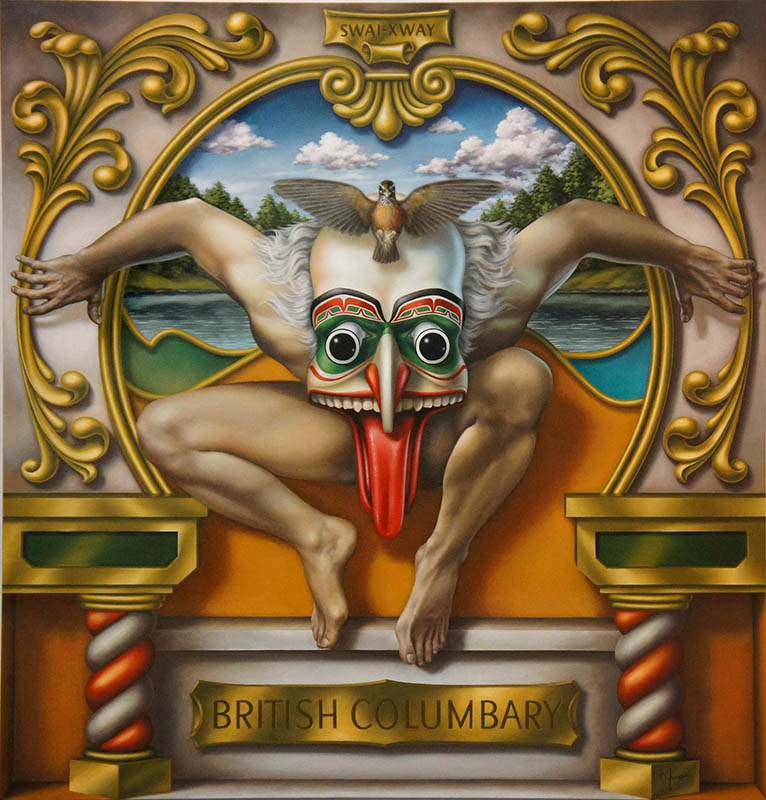
M.S-K.: This interview is illustrated with an image depicting the Indian deity called Swai-Xway. You devote yourself to studying the myths and legends of the Indian deities of Western Canada. Where do your interests come from for such a subject?
R.T.: I was inspired by the primordial carvings of the West Coast Natives to undertake art studies of their mythology as well. I formed an assumption that the Indian anthropomorphic deities, that is, those based on a human figure, are a reflection of a certain reality, not a product of fantasy. The presence of deities in the culture of the Pacific West Coast Natives is an important element in shaping the spiritual climate of the entire region, regardless of the ethnic origin of its inhabitants. In my paintings, even newcomers from the distant worlds become the centre of attention of local spirits. This type of assumption enabled me to introduce Indigenous mythological themes to the world of fully realistic devotional art grounded in imagination, as in the European convention of biblical themes beginning with Michelangelo.
M.S-K.: Thank you for the conversation.
___________________
Footnotes
- ^
Małgorzata Szymczyk-Karnasiewicz (8 August 2003), “Mowa ojczysta nie spowszednieje mi nigdy” ('My mother tongue will never lose its charm'), Głos, Tygodnik Nowohucki weekly, Kraków, No. 32 (644), page 9. ISNN: 1231-8582. Index nr: 358835. Full page interview with Richard Tylman. See full transcript of the Polish original by the author. Also: external link to current issue of Głos (The Voice) in Polish. (Return)
- ^
Anna Nasiłowska (2024), “Reduta Ordona” (Ordon Redoubt) in A History of Polish Literature translated by Anna Zaranko, Academic Studies Press, p. 185; ISBN 9798887192772. Mickiewicz's famous depiction of Ordon's self-sacrificial blast in the ballad Reduta Ordona (Ordon's Redoubt) was modelled on the famous image of the heroic 1826 explosion by the Greek elder at Missolonghi, reported by the emigrée press.(Return)
|
|
Acknowledgement
The poem “Nie-bywalec” was published in Koty marcowe (The Felines of March), 2002, by Wydawnictwo Nowy Swiat, Warsaw, Poland; pp. 68–. ISBN 83-88576-94-1. |

Special feature: the latest poems | More poetry featured |
Selections from Imaginary Lovers | Poems in Polish | Paintings and Narrative | View Guestbook |
Photo album | Cover page: about the author | O Ryszardzie Tylmanie po polsku
|