Wikipedia's frontiers
The other way around
By Richard Tylman (Wikipedia user Poeticbent)
Back in 2006 R.I.P. Aaron Swartz, a fellow Wikipedian, attempted to challenge the results of research presented by Jimbo Wales at Stanford – part of his standard talk. Wales revealed that over 50 percent of the total number of edits in Wikipedia were made by the shocking 0.7% of users; while 73.4 percent of all contributions, came from just 2% of them, 1,400 people in all. The remaining edits came from “people who [were] contributing … a minor change of a fact or a minor spelling fix.”[1] Skeptical yet curious, Swartz asked himself: “So did the Gang of 500 actually write Wikipedia?” He performed his own quantitative research, analyzing not the number of edits (pride and joy of long-established users); but rather, the actual letters per individual volunteer added into the current body of selected articles amounting to their actual content value.[1] The results were even more shocking. The study by Swartz has shown that, while the “insiders account for the vast majority of the edits,” it was the occasional contributors who provided nearly all of the content value there.[2] Swartz has alluded to the possibility that “newbie masses” may be the real life-blood of Wikipedia, not the “experts”.
Some time earlier Larry Sanger suggested that Wikipedia should stick to its core group of hard working insiders.[3][4][5] Swartz proclaimed exactly the opposite: “Wikipedians must jettison their elitism” and embrace the newbie masses with respect. He quoted Seth Anthony confirming his revelations. “The average content-adder – as Anthony commented – has less than 200 edits: much less, in many cases.”[3]
So did the newbie masses actually write Wikipedia? The fact is … we’re not supposed to know who the logged-in content-adders are. We can only speculate about their motives as if they were actual flesh and blood … which they aren’t. For once, the level of intellectual aggression in Wikipedia due to the presence of anonymity is exceedingly high. Some of the most common and most disturbing forms of behaviour include angry, vengeful, overstimulated reactions to criticism, assaultive language and poor impulse control; good enough reasons to be wary. The attempts to prohibit trolling failed at the onset of Wikipedia likely because in an Internet world trolling is good for traffic, and traffic is the real life-blood of Wikipedia.
The standard method of functioning; the Modus operandi of many entrenched “regulars” hasn’t changed in years … it has actually gotten worse. The utopian ideals of the Wikipedia community, constructed early on through options for instantaneous change, inadvertently solidified binary assumptions as well as the preexisting stereotypes, and at the present time often aggravate a combat mentality. By 2009 already, active accounts began to turn dormant by about 20,000 a month.[6] In real life – wrote Danah Boyd of Surrey University – individual people constantly manipulate their own identities in order to perform functions incompatible by nature. They assume a party-time persona or the workplace persona or others, without being ‘inaccurate’ about their own true selves. “It is not uncommon for individuals to have multiple email addresses or phone numbers as a way of controlling access to them. Most people are not interested in consolidating all of their physical or virtual identities into one.”[7] In Wikipedia … such behaviour is considered unacceptable.
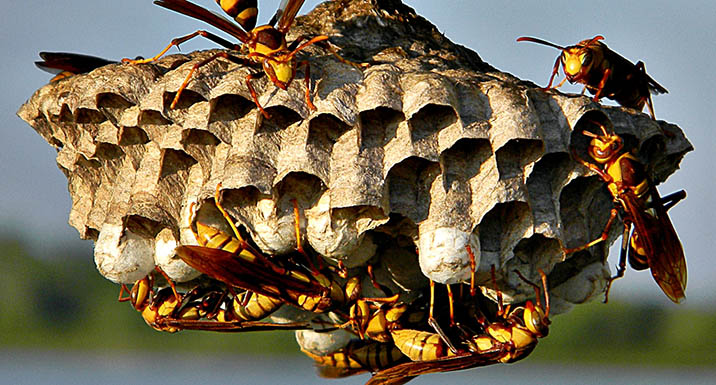
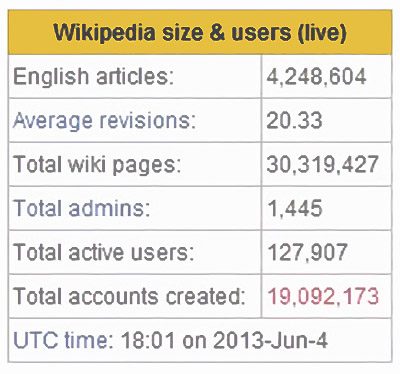
The success of Wikipedia affects the mind with a sense of overwhelming grandeur. We are on the forefront of today’s hottest web-based technologies. In his 2009 book The Wikipedia Revolution, Andrew Lih compared Wikipedia to an insect colony – commanded by stigmergy – built not by the will of anybody in particular and certainly not by consensus; but, by the participative instincts of humanity fuelled by Wikipedia’s unlimited “undo’s” coupled with article-histories revealing all “diffs” forever. Identifying the various types of database-providers cannot be reduced to simple dichotomies. Yet, the increasingly outdated policy/guidelines keep reducing all nuances of comparison into goodthink and crimethink, good old “insiders” and the evil-doers trying to stick it to the man.[8] The multiple personalities of an online identity constitute one of the more remarkable shifts in online social norms.[7] Wikipedia’s mopping crew has very few tools (and even fewer adequate ones) to address this phenomenon. Even though our sockpuppet policy permits the use of multiple accounts for various reasons; in practice, contributors are routinely penalized with no allegations of disruption.[9] Free to vanish entirely, they are prohibited from trying to evade those who have harassed and smeared them in the past. No wonder, the number of registered accounts exceeds the number of active users at a ratio of 130 to 1 (see chart, above). It is a symptom of an illness of anxiety almost impossible to compare with other similar projects.
Notes
-
[1.] Aaron Swartz (September 4, 2006).“Who Writes Wikipedia?” Raw Thought. Retrieved March 08, 2012.
Comments to: The other way around
- Eric Barbour June 5, 2013 at 1:29 pm
I might also add that Mr. Tylman knows whereof he speaks. He was heavily involved in the EEML/Digwuren squabble, which never ends. And not because he was “doing evil”, simply because he was doing valid content work on Polish subjects, and certain people didn’t like it. They were simply better at manipulating the diseased administrative layer of Wikipedia than he was.
http://en.wikipedia.org/wiki/Wikipedia:Sockpuppet_investigations/Poeticbent/Archive
http://en.wikipedia.org/wiki/Wikipedia:Requests_for_checkuser/Case/Poeticbent
http://en.wikipedia.org/wiki/Wikipedia:Arbitration/Requests/Enforcement/Archive44#Poeticbent